
About the carbon footprint of food
Let’s be honest hardly anybody looks at the carbon footprint of the food we eat. Buy local is the usual fall back answer. But a steak has just as high carbon footprint regardless where the meat was farmed. The carbon footprint of transport is not the major contributing factor.
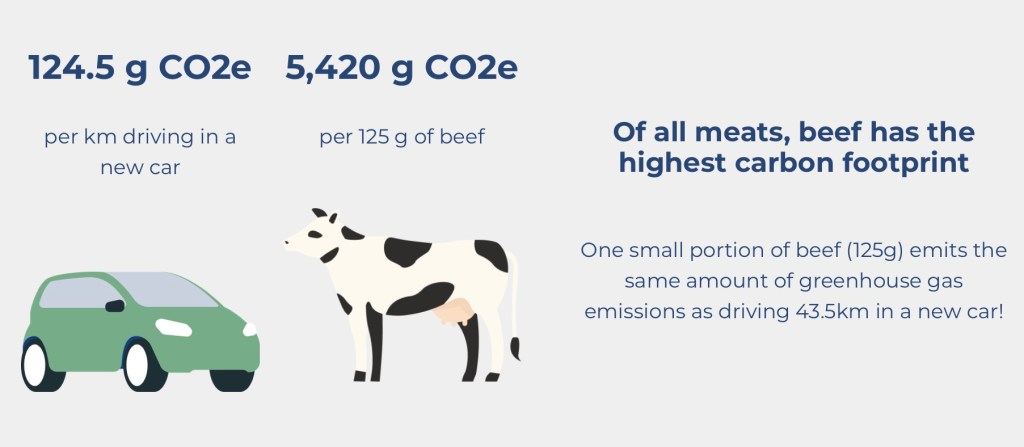
On the whole the carbon footprint on products on the supermarket shelves has nutritional information, but never the carbon footprint information. Research looks at the importance of a foods carbon footprint, how to calculate and understand the footprint.
The Graphics Research
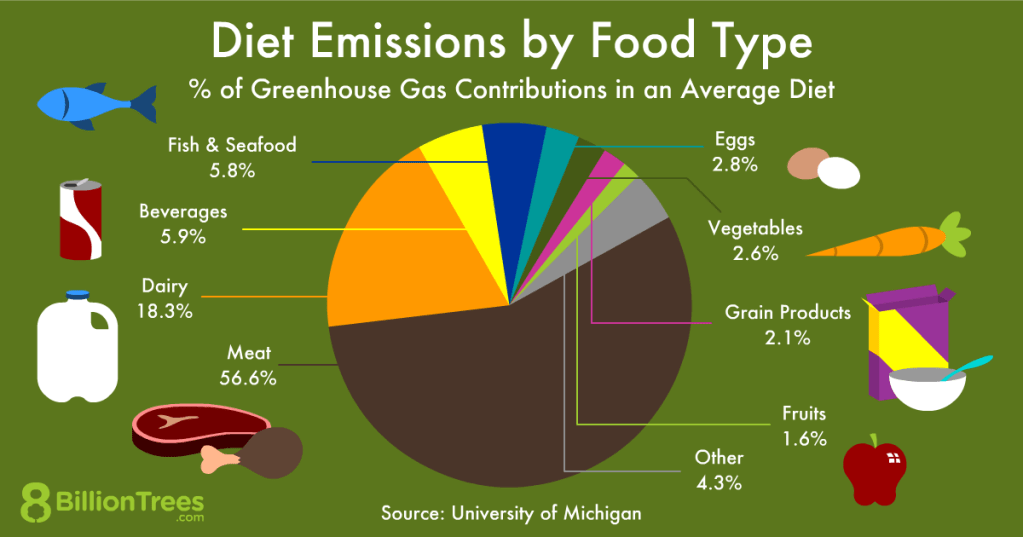
Agriculture and Horticulture Development Board
In the UK, it is currently estimated that 10% of the country’s total GHG emissions come from agriculture, equivalent to 46.3 Mt CO2e per year.
Emissions from transport (27%), energy supply (21%), business (17%) and residential (15%) are all higher than those from agriculture.
The main GHG emitted from agriculture is methane from ruminants (56%), followed by nitrous oxide from fertilisers (31%) and carbon dioxide predominantly from energy and fuel (13%).

Green Eatz
Changing the foods that you eat can have a big impact on your carbon footprint. And reduce pollution, preserve the environment and slow global warming. Many of these changes will also save you money, improve your health and even keep you fit!

The Economist
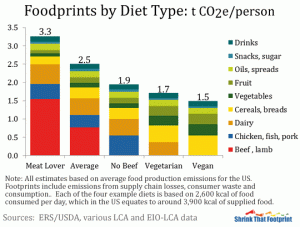
Eating a juicy steak is worse for the environment than frying up some tofu: that much should come as no surprise. Going vegan can dramatically cut the carbon footprint of your diet. But what about the fewer calories, and lower levels of protein, found in most plant-based foods when compared with meat? That makes it hard to compare emissions of meals that are equally nutritious.
The Visual Capitalist
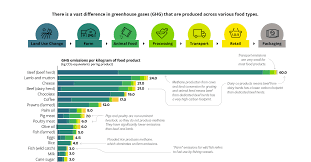
The quantity of greenhouse gases (GHGs) generated by our food can vary considerably across the global food supply chain.
In fact, the difference between specific food types can vary by orders of magnitude, meaning what we eat could be a significant factor impacting GHG emissions on the environment.

New Scientist
Food production contributes around 37 per cent of global greenhouse gas (GHG) emissions, showing the huge impact that our diets have on climate change. What’s more, animal-based foods produce roughly twice the emissions of plant-based ones.

The Anthropocene
Almost half the cumulative environmental impact of our food systems derives from just five countries. This, plus a host of other revelations about food impacts, have been shared in a new study, which its authors say could help tailor efforts to make global production more sustainable.

The link above will open an excellent website where you can easily calculate the carbon footprint of the food you eat.
Strategic actions
The research has shown that the food we choose to eat has a massive impact on the planets climate. Clear easy carbon footprint information needs to be standardised and the public happily making choices based on carbon footprint.
The bottom line is that a meat and dairy free diet of locally grown food, home cooked, is by far the best option
Action 1
To produce a range of low carbon recipes using a healthy local food supply chain.
Action 2
To provide veg bags and seasonal products to targeted households.
Action 3
To look at the potential of a local food cooperative which can provide a full range of grocery products and services, including a non wheat bakery.
 Growing Links Academy